
Click and Collect Concert Merch: How to End Merch Table Lines
 Marin ·July 10, 2026 · 8 min read
Click & Collect is changing how fans buy merchandise at shows and festivals. No more standing in a line for twenty minutes after the encore while the table shuts down and staff count cash by phone light. This is not a small problem: according to the CNM (Centre national de la musique, France's national music board), the country's live sector drew 37.9 million spectators across 69,663 paid performances in 2024, a crowd size that a single card reader and a manual cash box still struggle to serve. This article breaks down how Click & Collect works in the live context, what the data says about its benefits, and how to roll it out.
What is Click & Collect in a live context?
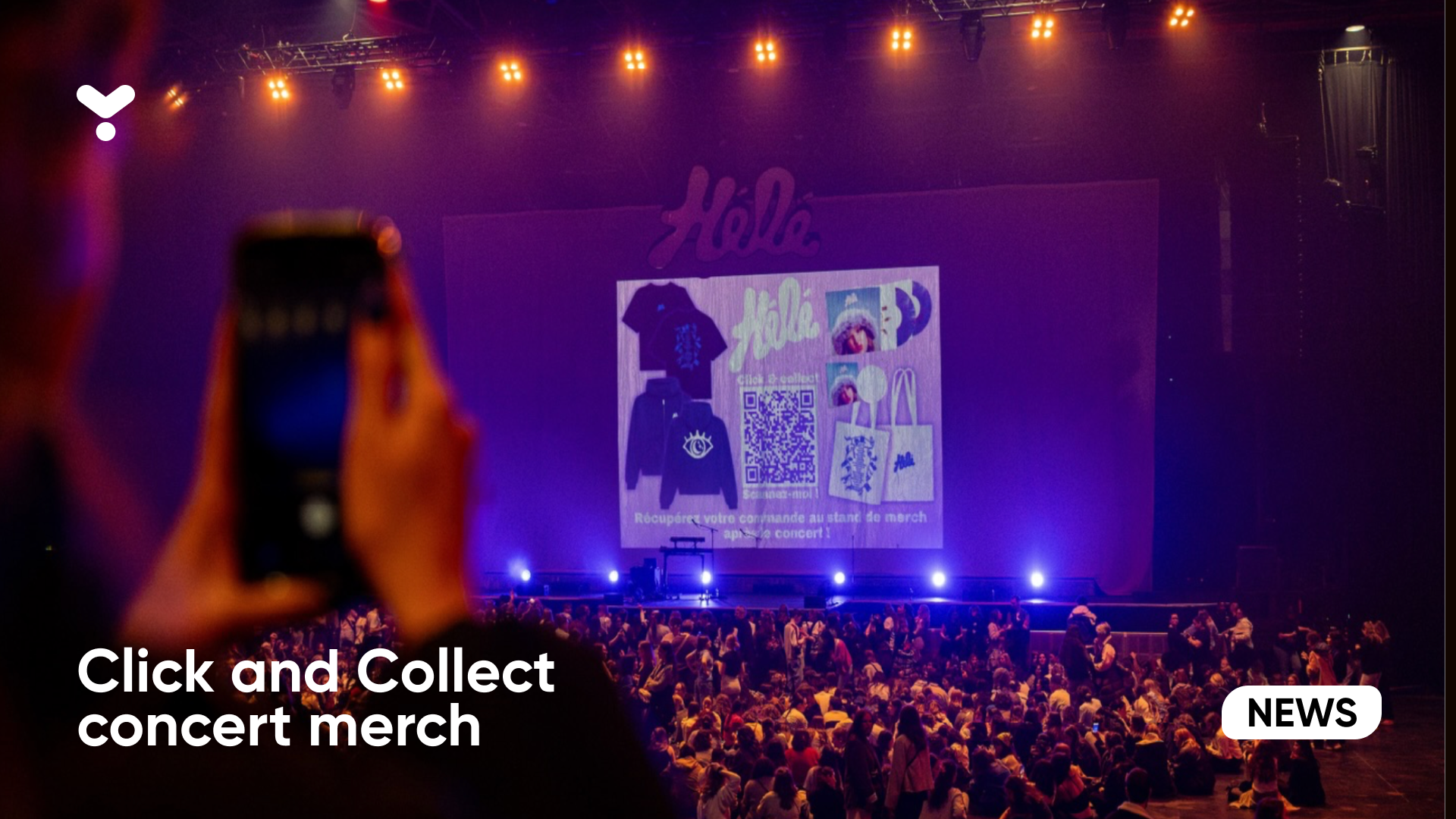
Click & Collect lets a fan order and pay for merchandise directly from their phone, seated, scan a QR code shown inside the venue, and pick up the order at a dedicated counter, without any queing required. The order is prepared by the staff and ready before the fan arrives at the table.
Unlike standard retail Click & Collect, where pickup can take hours or days, in a live context this happens in minutes, often during the encore. The fan scans a QR code displayed on the venue's screens, opens an event-specific online store, chooses a t-shirt or a vinyl, pays by card or Apple Pay, then collects the order at a marked pickup point instead of queuing. The model sits inside a wider shift toward direct-to-consumer (D2C) selling, where the artist or venue sells straight to the fan without a third-party reseller taking a cut.
Why do merch table lines cost venues and festivals real sales?
A long line at the merch table pushes part of the audience to walk away before they ever pay. Fans in a hurry to catch a train, or simply tired of waiting, skip the impulse buy that would otherwise have helped fund the tour.
The scale of the problem is structural. In 2024, France's live music sector drew 37.9 million spectators across 69,663 paid performances, up 2% year-on-year, according to the CNM. That crowd converges on the same 20-minute window every night: right after the last song, when everyone heads for the exit at once.
With one card reader and a manual cash box, the line grows, cash goes untracked, and staff spend more time making change than selling. A fan who waits fifteen minutes usually buys nothing at all: they leave.
There is also a clear appetite for something better. According to the Baromètre du Live (a recurring survey commissioned by Prodiss, the French live entertainment trade body, and run by pollster Harris Interactive, as reported by News Tank Culture), 63% of concertgoers say they are interested in more interactive, digital experiences at shows. Fans are already asking for a smoother path to purchase.
Superfans matter even more to this equation. Luminate's 2025 midyear report found that 73% of superfans buy artist merchandise, compared with just 26% of the general audience: the exact segment most likely to hit a merch table the moment the show ends.
How does click and collect work in practice with Yaarz?
Yaarz digitizes the full merch buying journey, from order to pickup, without traditional hardware. Fans order on their mobile via QR code, staff check out and prepare orders through the app, and every sale feeds a live dashboard. Here is the flow:
Screens in the venue or festival display a QR code linking to an online store generated automatically for that show or tour.
The fan browses the catalog, picks a size and item, and pays through the payment provider built into the app.
An order is queued for the pickup counter: no physical card reader involved.
Staff on the ground can also check fans out directly at the table (card, cash, or Tap to Pay on iPhone) for those who prefer to buy in person.
Every sale deducts stock automatically, item by item, size by size.
Sales of physical music (vinyl, CDs) are logged in a format ready for SNEP certification (the French recording industry body that certifies gold and platinum sales), with no manual re-entry.
This setup removes the standalone card terminal and its separate receipt tape. Payment is built in, mobile, and works equally well at a fixed counter or with a roaming seller working the crowd.
What are the concrete benefits of Click & Collect for venues, festivals and touring teams?
Click & Collect shortens perceived wait time, keeps stock counts accurate in real time, and makes sales reporting reliable, including certified music sales. For venues and festivals, it also opens up data that was previously invisible.
Table wait time —
Without Click & Collect: Single line, one card reader
With Click & Collect: Fast pickup, order already paid
Stock tracking —
Without Click & Collect: Manual count at the end of the night
With Click & Collect: Real-time stock, by size and SKU
Sales traceability —
Without Click & Collect: Untracked cash, frequent discrepancies
With Click & Collect: Every transaction timestamped and centralized
Music sales reporting —
Without Click & Collect: Manual re-entry for certification
With Click & Collect: Automatic feed, SNEP-ready
Tour-wide visibility —
Without Click & Collect: Scattered reporting, venue by venue
With Click & Collect: One consolidated live dashboard
For a touring team, real-time data changes how a run of shows is managed. Knowing by the third date that a particular t-shirt size is selling faster than planned means reordering before it sells out, not after.
The Yaarz model also relies on a community of 150+ "Yaarzer," salaried on-the-ground sellers rather than gig-economy freelancers, which keeps mid-size tours (venues in the 400 to 1,500-capacity range) financially viable while reducing the travel and carbon footprint of a scattered merch crew.
How do you set up Click & Collect at your venue or festival?
Setup comes down to three steps: build the product catalog and stock counts, display the QR code on screens already in the venue, and train the on-site team on the app. No extra card terminal or cash register is required. In practice:
Catalog and stock: each item, t-shirt, vinyl, poster, is loaded with sizes and quantities available per tour date.
Display: the QR code slots into screens already used for ticketing, the stage backdrop, or side screens, with no heavy install.
Staff training: sellers learn the app in minutes, checkout included (card, cash, Tap to Pay).
Live monitoring: the merch manager or tour manager checks the dashboard during and after the show.
The setup works the same way for a single venue or a multi-date tour, with every stop feeding into one consolidated dashboard.
FAQ: Click & Collect concert merchandising
Conclusion
Click and collect concert merch is no longer a novelty reserved for stadium tours. It is a direct answer to a problem every mid-size venue knows well: a merch table line that quietly erases its best-selling moment. Between stock nobody tracks, cash nobody sees, and data nobody reports, event merchandising remains largely under-optimized, in France and beyond, even as the global live music market, valued at roughly USD 38.58 billion in 2025 according to Custom Market Insights, keeps growing.
Yaarz, founded by Yohan Imakhoukhene and Kevin Muller and incubated at Station F, already supports tours and shows for artists including Bigflo & Oli, Orelsan, Zaho de Sagazan, PLK, Gazo, Tiakola, Harry Styles, Paul Mirabel, Ben Mazué, Santa and Helena, with more than €18 million in transaction volume processed.
Run a venue, a festival, or a tour? Request a Yaarz demo to see how click and collect concert merch can change your merch table.