

Merch settlement after a show: count in, count out, and settle with the venue without a midnight argument
 Marin ·October 29, 2026 · 12 min read
11:45 pm, the room is empty and the stand half packed away. The venue manager walks up, notebook in hand: "How many did you sell?" If nobody counted the stock before doors, the honest answer is a guess, and the venue's share turns into an argument.
On that same night, the share is 516 € or 619.20 €, depending on whether it is calculated excluding or including VAT. The fix fits on one line: units sold = starting stock + restocks − ending stock − comps and damaged items. This article runs the maths on a full fictional example, checks it against the till and shows the sheet both sides sign.
In short: count your stock before doors (count-in) and after the show (count-out). The difference, adjusted for restocks and for comped or damaged items, gives units sold. Check that figure against the till (card plus cash), apply the venue's agreed share, then sign one sheet that each side keeps a copy of.
What are count-in and count-out?
Before doors open you count everything, item by item, size by size: that is the count-in. Once the show is over and the stand is closed, you count again: the count-out. Everything that left the stand in between was sold, given away, broken or lost.

The method comes from Anglo-American venues. According to KQED, at The Fillmore in San Francisco artists counted their shirts and records in and out so the club could work out the night's income and take its share. In France the practice is less systematic, but it comes back as soon as a venue takes a percentage or a third party, such as a merch company or a label, has to be paid.
How do you calculate units sold?
One formula, applied line by line to each item (product, size, colour):
Units sold = count-in + restocks during the night − count-out − comped or damaged items.
An example with a medium t-shirt: 40 at count-in, 10 added at intermission, 12 at count-out, 2 given to the crew, 1 stained. That gives 40 + 10 − 12 − 2 − 1 = 35 units sold.
Two rules separate a number that holds from a number that gets challenged:
Count per item, never in bulk: a gap of 3 across 200 shirts tells you nothing, while a gap of 3 on size M tells you where to look.
Log every comp and every damaged item on its own line, with the reason (artist, crew member, defect). Those lines protect the seller when talking to the venue.
What does a full count look like? A fictional example
Fictional example: a 600-capacity venue, a touring band, four products. Prices including VAT: t-shirt 30 €, hoodie 55 €, vinyl 28 €, poster 15 €.
T-shirt S: 20 at count-in, 8 at count-out → 12 sold.
T-shirt M: 40 at count-in, 10 restocked at intermission, 12 at count-out, 2 comped, 1 stained → 35 sold.
T-shirt L: 40 at count-in, 14 at count-out, 1 comped → 25 sold.
T-shirt XL: 20 at count-in, 9 at count-out → 11 sold.
Hoodie M: 15 at count-in, 9 at count-out → 6 sold.
Hoodie L: 15 at count-in, 7 at count-out, 1 comped → 7 sold.
Vinyl: 60 at count-in, 31 at count-out, 2 comped to the artist, 1 warped → 26 sold.
Poster: 50 at count-in, 33 at count-out, 2 creased → 15 sold.
Expected revenue, product by product:
T-shirts: (12 + 35 + 25 + 11) = 83 units × 30 € = 2 490 €.
Hoodies: (6 + 7) = 13 units × 55 € = 715 €.
Vinyl: 26 × 28 € = 728 €.
Posters: 15 × 15 € = 225 €.
Expected total: 4 158 €.
On the sheet, the comps (6 items) and damaged items (4 items) appear separately: they leave the stock without reaching the till, and the artist or venue can check them.
The till shows 3 205 € by card, refunds deducted, and 1 073 € in the drawer, including a 150 € float, so 923 € of cash takings. Total collected: 3 205 + 923 = 4 128 €. The gap is 4 158 − 4 128 = 30 €, exactly the price of one t-shirt. A shirt left the stand unpaid and unlogged: a forgotten gift, or a missed sale. The 30 € goes on the sheet with that explanation. You do not "fix" it.
The venue's share then follows the contract. At 15 % excluding VAT on takings: 4 128 € / 1.2 = 3 440 € excluding VAT, so 516 € for the venue. On a VAT-inclusive base the same share would be 619.20 €. That 103.20 € difference is settled before the show, not at midnight.
How do you reconcile the count with the till?
Multiply units sold by your prices and you get expected revenue. The till gives you collected revenue. The two should match within a few euros.
Card: take the total from the payment terminal or the sales app, refunds deducted. This figure is not up for debate, it is timestamped.
Cash: count the cash drawer and subtract the opening float. Count in front of a witness, notes and coins.
Total collected = card + counted cash − float.
Gap = expected revenue − total collected.
A practical benchmark: a gap under 0.5 % of expected revenue (about 20 € on 4 158 €) is almost always a wrongly given change. Beyond that, investigate.
What if the count and the till do not match?
Look in this order, from most to least likely:
Recount the items concerned, not the whole stand. If the gap equals a multiple of a price (30 € = one t-shirt, 55 € = one hoodie), start with that product.
Re-read the comp and damaged lines: a comped item with no note looks like a missing sale.
Check the restocks: a box added at intermission but missing from the sheet creates a large gap in value.
Check the card total: an undeducted refund, or a declined payment counted as successful, skews the result.
Recount the cash in front of a witness, making sure the float was removed.
Log the remaining gap on the sheet with your most likely explanation, then sign.
Watch out: never alter a count to make the figures add up. An explained gap holds up, an adjusted number does not.
How do you organise the count with two people, and how long does it take?
Count in pairs: one reads out loud, the other writes, and every line is checked twice. At count-out, swap roles: whoever counted at count-in holds the pen.
Rough guide for a small 400-capacity venue and about ten items: 10 to 15 minutes before doors, 15 to 20 minutes after the show, drawer included. With 30 items or several stands, double it. Finish before the venue closes access: count-out happens with the stand closed, before pack-down starts.
In a larger venue, the house often sends its own representative. Good: they count with you and sign, so nothing is left to dispute. A support act selling from the same stand gets its own sheet.
How do you handle sizes and variants?
A black t-shirt in M and a black t-shirt in L are two lines. A white one in M is a third. An item is one product, one size, one colour.
Sort by item before counting: a pile of black M, a pile of black L, and so on. A count on a mixed pile gets redone.
Label the boxes with the starting quantity, so the count-in can be checked at a glance.
Log size exchanges: if a customer swaps an L for an M, stock moves without a sale. Write it down (one L in, one M out), or both lines are wrong.
Watch bundles: a t-shirt plus vinyl pack uses one unit of each item. Calculate units on the items, never on the pack.
How do you count a multi-day festival?
At a three-day festival, count at the opening and closing of each day. The evening count-out becomes the next morning's count-in, provided the stock stays locked or sealed overnight. If not, recount in the morning and log the difference.
One count per day and per stand: a 20 € gap on Friday can be traced, a 60 € gap discovered on Sunday across three days cannot.
Transfers between stands are logged as an outflow on one stand and an inflow on the other. The two lines cancel out and total stock stays right.
Truck restocks are checked on arrival against the delivery note, before they reach the stand.
The venue's or organiser's share is calculated on the three-day total but checked day by day. For more on stock, see our article on festival merch inventory management.
How do you calculate the venue's share?
The venue's share is not invented after the show: it is set before the date, in writing (contract, tech rider or email thread). In France, venues charge either a percentage or a flat fee; how to compare them is explained in our article on venue merch fees. In the US, according to KQED, venues commonly take 15 to 35% of sales.
Four points to fix before the show:
The rate: a percentage of sales, or a flat fee. Write down the exact figure.
The base: excluding or including VAT. On 1 000 € including 20 % VAT, the base excluding VAT is 833 €. At 15 %, the difference shows: 125 € against 150 €. Also state whether card fees are deducted before the calculation.
The items covered: all merch, or only some products. Records, third-party products or comped items are sometimes excluded.
When and how it is paid: bank transfer after the show, or deducted on the spot in cash. A late transfer needs a written deadline.
What must the settlement sheet contain, and who signs it?
The settlement is signed by one representative of the tour team (tour manager, merch manager, seller) and one representative of the venue (production manager, bar or front-of-house lead). Each leaves with a copy, on paper or as a PDF.
The settlement sheet contains, in this order:
The header: date, venue, name of the artist or merch company, names of the two people who counted.
The per-item table: product, size, colour, unit price, count-in, restocks, count-out, comps, damaged, units sold, amount.
Non-sale movements: comps and damaged items in detail, with a name or reason.
Takings: card total (refunds deducted), counted cash, float, total collected.
The gap: expected revenue, total collected, difference and explanation.
The venue's share: rate or flat fee, base (excluding or including VAT), amount due, payment method and date.
The close: time and both signatures.
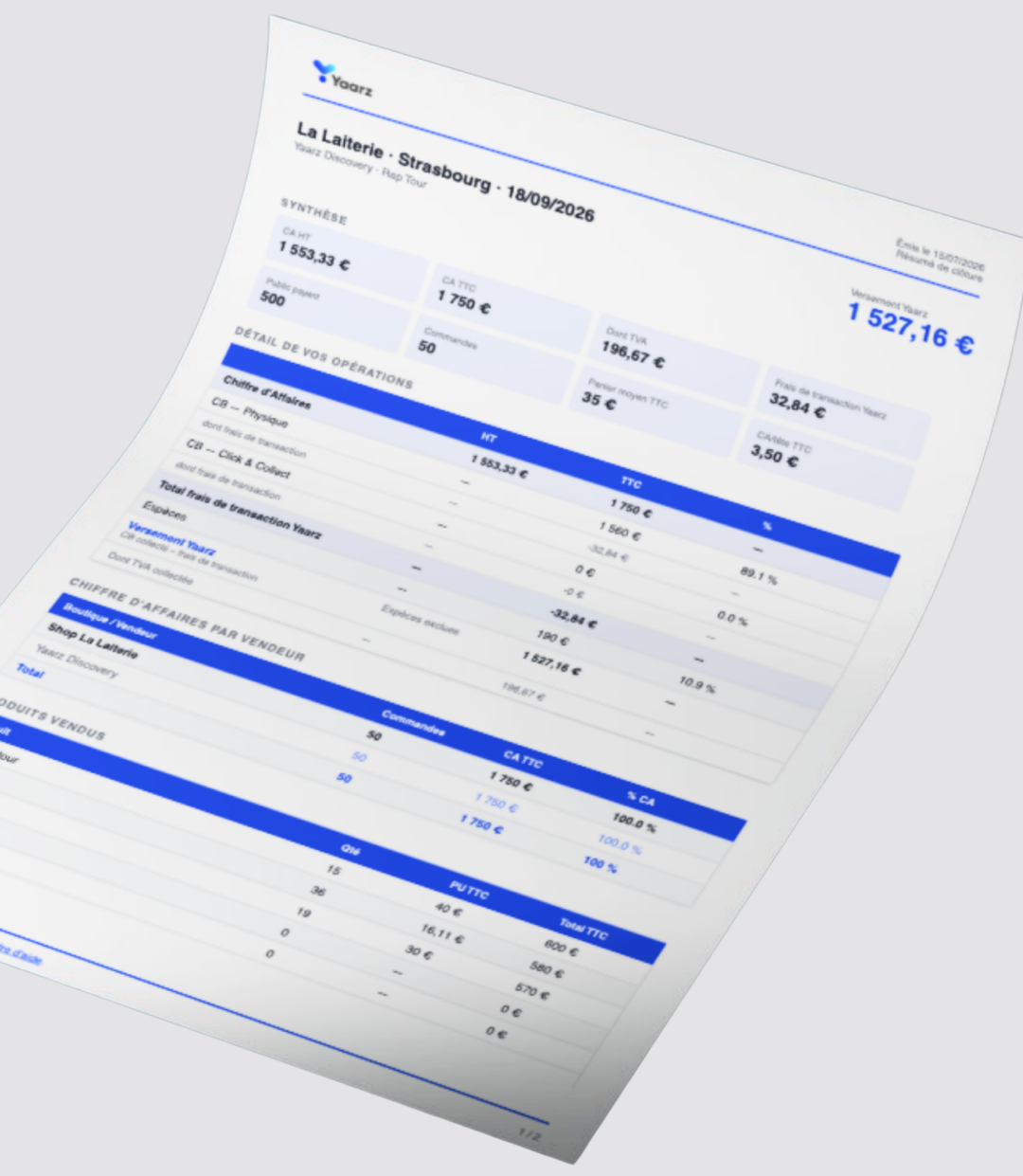
With a sales app, sales and stock are already counted, so only the gaps remain. Yaarz handles the cash closing and the venue fees paid (cash or bank transfer) on tour, and venues in concession mode sign the closing on screen. For the payment side, see Tap to Pay on iPhone at a merch table.
Checklist: the count, step by step
Before the show:
Get the rate, the base (excluding or including VAT) and the covered items written into the contract or an email thread.
Ask who on the venue side will sign the settlement.
Before doors:
Count the stock in pairs, item by item, and log the count-in.
Prepare a known, written-down float.
During the show:
Log every restock with the time.
Log every comp or damaged item, with the reason.
After the show:
Close the stand and count the remaining stock: the count-out.
Apply the formula to get units sold per item.
Take the card total and count the cash in front of a witness.
Compare expected and collected revenue, and explain the gap.
Calculate the venue's share using the agreed rate and base.
Sign, photograph the sheet, and each keep a copy.
The eight mistakes that spoil a count
Negotiating the share after the show: with no written deal, the rate and the base become an argument at midnight.
Skipping the count-in: with no starting point there is no calculation, and "theoretical" stock is only an estimate.
Counting in bulk: a total per product hides a size error. Count per item.
Not logging gifts: every unlogged free t-shirt becomes a gap, then a suspicion.
Forgetting the intermission restock: it is the mistake that weighs most in value, since a box of 10 is worth 300 € of t-shirts.
Mixing the float with sales: a drawer counted without removing the float inflates cash sales.
Counting alone, or late: a solo count at 1 am gets redone. Keep one extra person and finish before the pack-down.
Adjusting figures to make them add up: an explained gap holds up. An adjusted number undermines the whole sheet.
Read next: Festival merch inventory management and Average basket size and revenue per head in live merch sales.
Also on this topic: venue merch fees and how much to charge for band merch.