
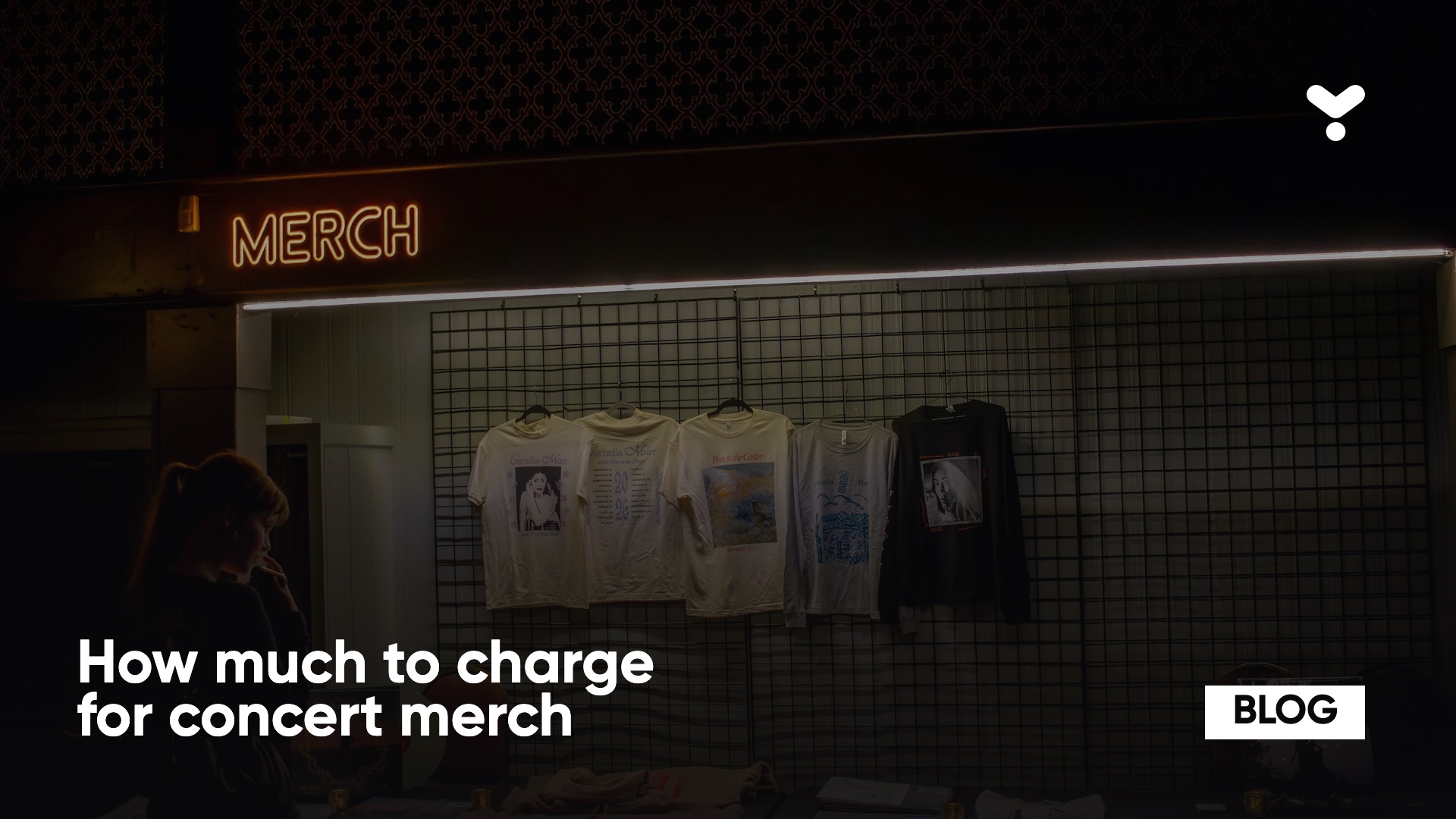
How much to charge for band merch: tees, hoodies and vinyl, without losing on the night
 Marin ·October 29, 2026 · 13 min read
Saturday, 8:55 pm, packed room. A fan stops at your stand, looks at the tee, looks at their phone, walks off without a word. They just compared your price with last week's band. On a tee that costs you €8, €30 leaves you €17 of margin. €27 leaves €14.50.
There is no official price for concert merch. Every artist sets their own from what the item costs, what their audience will pay and what the show costs them. This article gives you a method to price each item (tee, hoodie, vinyl, poster), build a consistent range, work out your margin and display your prices at the stand. Every figure in the examples is fictional.
In short: build three price tiers (entry product, core range, premium), set each price from your unit cost multiplied by a coefficient, compare it with artists of a similar size, show round VAT-inclusive prices and check your margin after the costs of the date (venue, seller, card fees).
What are the price references for tees, hoodies and vinyl?
There is no public price grid for France. A few public references from abroad:
In the UK, a guide for event organisers puts event tees at £15 to £25, and £25 to £35 for a premium or limited edition.
In 2023, a £40 tee on Gojira's UK tour sparked a debate about merch prices: past a certain point, fans notice and say so.
The best reference is your own audience. Look at what artists of your size, in your genre, charge in the same venues. A fan who knows the usual price of a tote bag, a poster or a cap compares at once. Pick three or four direct peers, note their VAT-inclusive prices, then place yours inside that range or be ready to justify the gap: design, fabric, limited run.
How much should you charge for a tee at a show?
The tee is the stand's central item. Its price sets the level of the whole range.
Start from your cost and apply your coefficient (see below).
Compare with artists of a similar size: a price well above theirs needs a strong design, visibly good fabric or a limited edition.
Place the hoodie clearly above the tee so it plays the premium role.
Avoid prices that look arbitrary: a tee at €27 and a hoodie at €55 look pulled from a hat. €30 and €60 stick.
Three tiers are enough: entry product, core range, premium
A good range gives every budget a choice.

The entry product (€10 to €15): poster, tote bag, CD. The no-hesitation purchase for a fan who wants a keepsake.
The core range (€25 to €30): tee, vinyl, cap. What most fans come for.
The premium (€50 to €60): hoodie or collector bundle. It will not be your biggest seller, but it makes the core range look reasonable by comparison.
These amounts are examples, not market prices. Keep the range short: five to eight items can be read at a glance. To size quantities, see our guide to selling merch on tour. For records, see our article on certified record sales on tour.
Unit cost × coefficient: the method that works for any product
Start from the unit cost before tax: manufacturing, printing, labels, packaging, shipping if you pay for it.
Pick a coefficient: pre-tax selling price divided by unit cost. A coefficient of 3 means you sell at three times what the product cost you.
Convert to a VAT-inclusive price: multiply the pre-tax price by (1 + VAT rate), then round to the nearest round price.
Example: a tee costs €8 before tax. With a coefficient of 3, the pre-tax price is €24. At 20% VAT that gives €28.80, rounded to €30. That round price is €25 before tax: an actual coefficient of 3.1 and a gross margin of €17 per tee.
No coefficient is universal. It depends on your cost, your volumes and what your audience will pay. Compare the resulting price with what artists of a similar size charge, then subtract what the date costs: venue fees, a seller, card fees (see below).
What does a complete, priced range look like?
Fictional example: a band orders six items. The coefficient falls as the price rises, because a fan compares a €60 hoodie with other hoodies, not with your cost price. The margin in euros still goes up.
Poster: cost €1.50, price €10 including VAT, or €8.33 before tax. Coefficient 5.6, margin €6.83.
Tote bag: cost €3, price €15 including VAT, or €12.50 before tax. Coefficient 4.2, margin €9.50.
Cap: cost €6, price €25 including VAT, or €20.83 before tax. Coefficient 3.5, margin €14.83.
Tee: cost €8, price €30 including VAT, or €25 before tax. Coefficient 3.1, margin €17.
Vinyl: cost €12, price €30 including VAT, or €25 before tax. Coefficient 2.1, margin €13.
Hoodie: cost €22, price €60 including VAT, or €50 before tax. Coefficient 2.3, margin €28.
Two takeaways. The poster alone earns €6.83, so its job is to bring a second item into the basket. The vinyl, at €13 of margin, earns less than the tee at the same price. That is normal: it costs more to manufacture (more on this below).
After the venue, card fees and the seller, what is left?
A margin per product is not a profit per night. Take a fictional show: €1,800 of sales including VAT, or €1,500 before tax. With an average coefficient of 3, the goods you sold cost you €500.
Venue at 20% of the pre-tax amount: €300.
Card fees: 90% of sales go through cards, at a fictional 1.5%: €24.30.
Seller: €100 for the night.
What is left: 1,500 − 500 − 300 − 24.30 − 100 = €575.70, or 38% of pre-tax revenue.
Watch out: if the same venue takes 30% of the VAT-inclusive total, its cut becomes €540 and only €335.70 is left. The displayed prices did not move, yet the night earns €240 less.
Before you set prices, know the venue's basis and rate: see venue merch fees.
Small venue, festival, support slot: should prices change?
No. Keep the same prices across the whole tour: fans compare what they see at the stand with what they saw online or heard from a friend. What changes from one date to the next is the range on display and the quantities you carry.
Small venue or club: audience close to the artist, basket often limited to one item. Push the core range and one entry product, carry little premium stock.
Large venue or festival: more casual fans and more impulse buys. The hoodie and collector editions earn their place, with a stand readable from afar.
Support slot: you sell to people who do not know you yet. Two or three items, entry prices, no premium. A moderately priced record or tee often makes most of the night.
Headliner: the crowd came for you and accepts a premium price and a limited run more easily.
If you change country or currency, recompute the VAT-inclusive price with local VAT, then round. A converted price down to the cent is hard to read at a stand.
Limited edition or signed item: how much more can you ask?
Scarcity justifies a higher price as long as it is real and visible.
Number or date it: "200 copies", "2026 tour edition". Never go over the announced run.
Count the hidden cost: signing takes time. Sign stock in advance, otherwise sales are capped by how many signatures fit into the night.
Set the gap with the standard version: fictional example, a standard tee at €30 and a numbered version at €45. If the numbered one costs €4 more to produce, it earns €8.50 more margin before tax from a fan willing to pay for the object.
Flag the product in your checkout ("signed", "numbered"), or the remaining stock becomes unreadable.
A vinyl is not a tee: the coefficient changes
A vinyl costs more to manufacture than a tee, and its selling price is capped by what fans are used to paying. The coefficient is lower, often close to 2 (see the fictional range above). Three habits:
Match the show price to your label's or distributor's shop price: a gap in either direction gets noticed.
Use the CD or vinyl as the anchor of the core range, and rely on apparel for margin.
Pair them: a vinyl and a tote bag, a CD and a poster.
Do bundles raise the basket?
They can, if the bundle is simpler to buy than the items separately. The classic pattern pairs a core product with an entry product: a tee and a poster, a vinyl and a tote bag.
A tee (€30) and a poster (€10) cost €40 separately, so a €35 bundle is understood at once. Create it in your checkout tool, because a discount keyed in by hand skews stock. See our festival inventory guide.
Check the margin after the discount. Fictional example: the tee costs €8 and the poster €1.50, so €9.50 in total.
Separately: €40 including VAT, or €33.33 before tax, margin €23.83.
As a €35 bundle: €29.17 before tax, margin €19.67. The discount costs €4.17 before tax per bundle.
Against the tee sold alone: margin €17. The bundle gains €2.67 if the poster persuades a fan who would have bought only the tee, and loses €4.17 if that fan would have bought both anyway.
Limit yourself to one or two bundles and watch the share of baskets that contain them. If nearly every fan takes the bundle, it no longer grows the basket: it only lowers your price.
VAT: show the VAT-inclusive price, think pre-tax
Show prices including VAT: the fan pays the displayed price with nothing added at the till. For your margin, think pre-tax, because VAT is not income. The maths is simple: pre-tax price = VAT-inclusive price divided by 1.20 at 20%. A €30 tee is €25 before tax, with €5 of VAT passed on to the state.
The standard rate is 20% in mainland France (Your Europe, European Commission). The rate depends on the product: the list is in articles 278-0 bis to 279 bis of the French tax code, according to service-public. Check the rate for every item in your range, and your VAT regime, with your accountant. This is not tax advice.
What card payment changes
Round your prices: €30 rings up faster than €29.90, which matters when the queue builds. In cash, a round price avoids change. By card there is no change, but a basket of €15, €25 and €30 comes to €70, and a fan checks that in their head. Card payment frees you from one constraint: you can aim for €28 or €32 if your margin requires it. Keep whole-euro prices.
Card fees weigh on margin, especially on small baskets. They depend on your payment provider's contract: a percentage, sometimes plus a fixed amount per transaction. Fictional example at 1.5% plus €0.10: a €10 poster pays €0.25, or 2.5% of its price; a €60 hoodie pays €1, or 1.7%. Include these fees in your margin calculation. To take cards with an iPhone, see Tap to Pay on iPhone for a merch table.
When should you raise prices on tour?
Three signals justify a rise: an item sold out in the first dates, a manufacturing cost that goes up at reorder, and demand that holds when you match artists of your size.
Raise in whole-euro steps and test over three or four dates before drawing conclusions.
Work out the threshold: fictional example, a tee goes from €30 to €33 including VAT. Margin goes from €17 to €19.50 before tax. As long as you lose less than 13% of sales (1 − 17 / 19.50), you earn more.
Prefer a new product to raising a familiar one: a fan sees at once that an old tee went up €3.
Change the price everywhere at the same time: stand board, online store and Click & Collect. Never mid-show.
Displaying prices: readable from three metres
A price nobody can see from three metres slows the queue. Every question costs you a sale.
One single board, readable from a distance, with the product and the VAT-inclusive price in large type.
Products grouped by tier: entry product, core range, premium.
The same price everywhere: stand, online store and Click & Collect.
Payment methods shown: card, Tap to Pay and cash.
Yaarz is the sales software artists, merch companies and concert venues use at their shows: mobile checkout (card, Tap to Pay, cash), a Click & Collect store, live stock tracking show by show, and automatic reporting of record sales to SNEP.
Seven pricing mistakes that cost you
Copying other artists' prices without knowing your cost: you match the price of someone whose coefficient is not yours.
Forgetting the venue, the seller and card fees: product margin is not the margin of the night.
Calculating margin on the VAT-inclusive price: €30 including VAT is €25 of revenue, not €30.
Multiplying items: past eight, fans hesitate and the queue slows down.
Wild end-of-night sales: a fan sees the drop and waits for the next date. If you clear a design, do it at the last show or online.
Discounts keyed in by hand: stock and margin become wrong. Create a bundle instead.
Forgetting free items: a tee given to the crew or press is a cost, so count it.
Read next: Average basket and revenue per head · Click & Collect for concert merch
Also on this topic: merch settlement after a show, venue merch fees and Tap to Pay on iPhone for a merch table.